Category Archives: arts

Watching the watchers – how VR can be a participatory experience

This past winter, virtual reality “exploded” at Sundance. VR technology is not new thing, but in the first part of this year it seemed as if every other film-related article was about it.
1422989297Image2_Davos

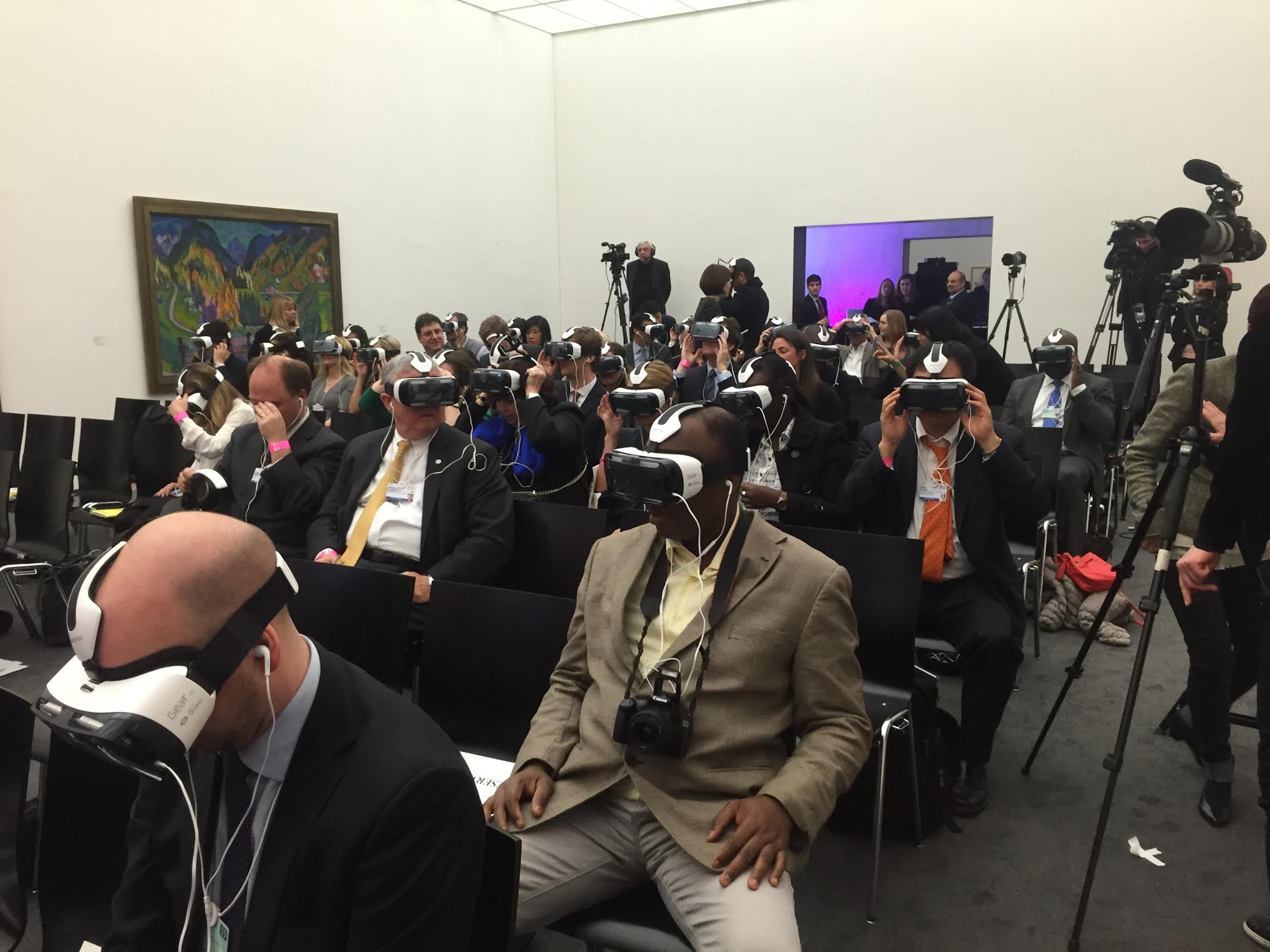
Clouds Over Sidra screens at Davos. Photo: Socrates Kakoulides

I’ve always been a bit skeptical. With most new formats and technologies, I find that people get really excited about the bells and whistles, but don’t spend as much time focusing on quality content. It takes a little while for the “fervor of the new” to die down, and for people to realize that just because something uses a new technology, it doesn’t automatically mean the finished product is actually interesting.

I had my first experience with VR at last year’s Tribeca Interactive, when I saw Nonny de la Peña’s Use of Force. It’s an immersive VR experience, where the viewer is observing a deadly beating of a migrant by Border Patrol agents at the U.S.-Mexico border. It’s chilling. I mean, I’ve seen dozens of docs about border and migrant issues and am well-read on the subject. But this was gutting. You’re watching this altercation, and the fellow observers “on-screen” are yelling to stop and trying to intercede, but there’s nothing that they – or you – can do. And you feel so at a loss. It is in your face, and you are powerless. And you realize that people of color face situations like this every day, and not just on the border.

Returning to Tribeca Interactive this year, I saw another piece that blew me away. It was Chris Milk’s Clouds over Sidra, which follows a twelve-year-old in the Za’atari camp in Jordan. Unlike the animated Use of Force, this is documentary footage, taking you on the streets and into homes at the camp. You feel like you’re there. Maybe it was so striking because I have been there, and it captured the essence, the presence, so well. It brought it all back. Would it have the same poignancy for someone who was witnessing it from the outside.

Both of these pieces show the potential for a new kind of journalism – sharing reality with viewers through a visceral immersion that writing or photography can’t provide. But what makes this possible is the very thing that VR is often criticized for – that it isolates the viewer from others and the experience is only possible as a solitary experience.
IMAG0455

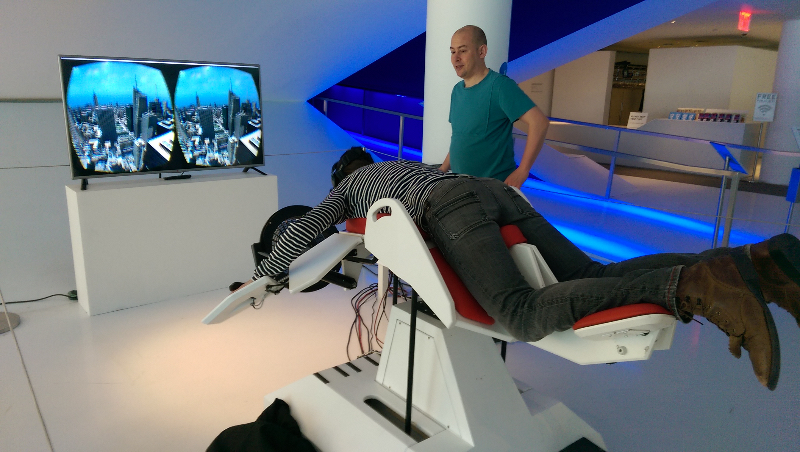
Birdly installation. Photo: Museum of the Moving Image

I do see this as an issue, but wonder how different this is from so many other platforms. Does watching Netflix on your phone with headphones not do the same thing? Viewing something on your computer, even without headphones, is still mostly only for single consumption. And say you could create “theaters” for VR exhibition – would a bunch of people sitting in a room with headsets really be very different from wearing 3-D glasses? Even though the glasses don’t make it a personal experience, just the presence of something that stands between you and your neighbor adds a level of distance.   The difference with VR is people can usually affect what they see by the movement of their heads, making the experience no longer collective, as a 3-D movie would be.

But recently I discovered an interesting angle of “crowd participation” for virtual reality material. A few months ago, I visited the Museum of the Moving Image’s Sensory Stories exhibition, a diverse collection of virtual reality and interactive pieces. When you first entered the museum space, the Birdly installation was set up. You don a headset, lie down on a platform and get strapped into wings, which control your movement onscreen. And thus, you have the chance to be a bird flying over Manhattan, dipping between buildings and soaring over Central Park in the wind (a.k.a. a fan).

Here’s the funny thing – being in line (which of course was quite long) was almost as fun as being in the installation. Watching the movements (something flailing, sometimes smooth) of others and experiencing the reactions of what they were seeing (smiles, exclamations of wonder, pleas of help because they were about crash) was enjoyable as its own “experience.”

Another section had four stations featuring immersive experiences – including Evolution of Verse (another piece by Milk) and Herders. Félix Lajeunesse and Paul Raphael’s Herders is an amazing fly-on-the-wall observation of a community of nomadic yak herders in Mongolia. You have 360 degrees to observe the landscapes or the family in their yurt. Like Sidra, it brought back memories for me and captured the essence of place, particularly in details – the vastness of the landscape, the ceiling of the yurt.

I generally am moved more by the reality pieces than animation or graphic demonstrations, but Evolution of Verse is filled with magical moments. And as I sat waiting, I was again caught up in people’s experiences. You see their heads turn and lift and feel their sighs of wonder as they are watching. There’s a dynamic moment where something special happens on screen and observing viewer’s reactions over and over from viewers is kind of magical. Especially because I hadn’t seen it yet. What were they seeing? Would I feel the same way? When I got to that moment in the piece, I had the same reaction as the others, and felt like I was sharing something with those viewers, even if we weren’t watching it together.

So, in a weird way, there IS a communal aspect to VR, in the sense that the process of watching something becomes an installation of its own.

– Karen Cirillo

What is art good for?

We’re in an age where everything seems to be quantifiable, whether it’s page views or Facebook likes or Twitter shares or how many people showed up for an event.* Or at least there are a lot of people and organizations out there that feel the need to quantify what we produce, what impact we’re having. This is not a bad thing necessarily, especially not when it comes to social campaigns or advocacy projects.

So is it elitist to want art to exist on a plane that’s different from the “quantifiable”? I’m not even speaking about the art for art’s sake idea – for art can indeed be a tool for social activism – but also from the standpoint of personal connection and exposure.

Zanele Muholi (South African, born 1972). Faces and Phases installed at dOCUMENTA (13), Kassel, Germany, 2012. (Photo: © Anders Sune Berg)

Zanele Muholi (South African, born 1972). Faces and Phases installed at dOCUMENTA (13), Kassel, Germany, 2012. (Photo: © Anders Sune Berg)

Lately, I’ve been devoting a lot of time to lectures, exhibits, and cultural exploration and it made me realize something. Aside from enjoying what I’m seeing and being inspired by different perspectives, I’m continuously learning about the world around me. It’s the comment that makes me think about something in a different way, or a series of photographs that evokes someone else’s state of mind, or a film that reveals to me that there’s a subculture within a subculture within another culture that I didn’t even know about.

And I think that’s one aspect of how art can connect us to what’s outside ourselves, and sometimes even make us realize what we never thought of as being inside ourselves.
Continue reading

Americana: History Viewed Through Artifacts

Leth_66Scenes-300x214

66 Scenes of America

The new Winter/Spring Flaherty NYC series That Obscure Object of Desire , curated by filmmakers Pacho Velez and Sierra Petengill, continues tonight with the Americana program.

I spoke with Velez and Petengill about their entire series, which I’ll publish soon, but in the meantime, some thoughts on tonight’s program to whet your appetite.

Q: What about using objects to tell a history?

Sierra: There’s something interesting happening in the program – the Jorgan Leth film is an older piece, but we’re viewing it in 2015 – the gap between the year of the making and the year of viewing changes it. We’re also showing Real West, which is just made and returning to a historical place, or to recreate a historic time. They’re both historical films, but from very different ends of the spectrum.

Q: Can you elaborate on the idea of Americana buttressing national ideas of mobility and entrepreneurship? How do we see that through the Americana films?

Pacho: One of the concrete objects through which we understand these ideas and perpetuate these ideas of America – the notion that we can travel all over it geographically, and also the idea of social mobility that’s implicit through that geographical travel. This “can do it” American value. These things are abstract. How do you codify these ideas? What are the objects that contribute to fetishizing these ideas? Cars; the open road and highways; the single family home; fast food – all of which make appearances through these films.

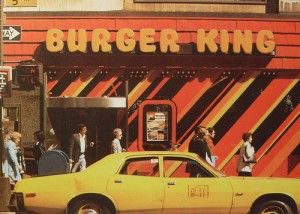
I just watched 66 Scenes of America again for a class I’m teaching. There’s a scene inside of it, a very famous scene, where Andy Warhol eats a hamburger. There’s the Burger King logo and the Heinz ketchup bottle, things that make me reminisce about my childhood. I’m sure at the moment it was shot, it didn’t feel like a very nostalgic gesture. When one reads about Pop art, it’s often posited as ‘new,’ ‘contemporary,’ ‘in the moment,’ clearing away past artistic ideologies (abstract expressionism, cubism, Social Realism, etc). But, of course, the mass advertising culture that Pop was mirroring has now been with us for so long, and is in many ways being displaced by the online digital world, so that certain icons of pop have started to make me feel nostalgic, or sentimental for ‘the way things used to be.’ Modern consumer gestures have aged in their own way. They’ve gained a kind of sentimentality, gained a historical nostalgic that I imagine Pop artists would be horrified at.

Check out the Americana program if you can.   The series runs every other Tuesday at the Anthology Film Archives in New York.

We Walk Their Path

This weekend, the OneMinutesJr. awards were announced and “We Walk Their Path,” by Amar, won the One Minute of Freedom award. The film was produced during a workshop I facilitated in Zaatari, the Syrian refugee camp in the north of Jordan.

There are so many stories from that trip – tales of kids uprooted from their homes, remembrances of lost items and childhood adventures, consistent declarations of an eventual return to Syria. All the kids in the workshop lived at Zaatari, some having been there a year and a half already. The majority came from Daraa, a city in southwestern Syria, just north of the border with Jordan. At the time of the workshop, in January 2014, the Zaatari camp hosted about 85,000 refugees from the conflict in Syria.

IMG_0823

I had facilitated workshops in over 20 countries at this point, so I was no stranger to challenging work environments. In addition to the physical containment (our movement was extremely limited) and the emotional impact (of witnessing life in the camp), there was the hurdle of general inexperience. Most of the seventeen participants of the workshop had never held a video camera before and their image-taking experience was mostly limited to mobile phones. The ideas behind creating imagery were fairly distant for them. But while they didn’t outright grasp the concepts of filmmaking, their imaginations never lacked.

As you can imagine, there are many stories to be told. But, for now, a focus on Amar (first name only, for security’s sake) and his tale of war.
Continue reading